
As many as 15 startup IPOs hit the markets this year, raising Rs 40,000 crore, over 35 percent more than in 2024, as stronger earnings, clearer profitability paths and deeper investor appetite drove demand

he new-age IPOs that hit Dalal Street in 2025 have unlocked nearly Rs 40,000 crore in public-market capital — a sharp jump from last year — as a decline in late-stage private funding directly pushed more startups to list rather than pursue additional growth rounds.
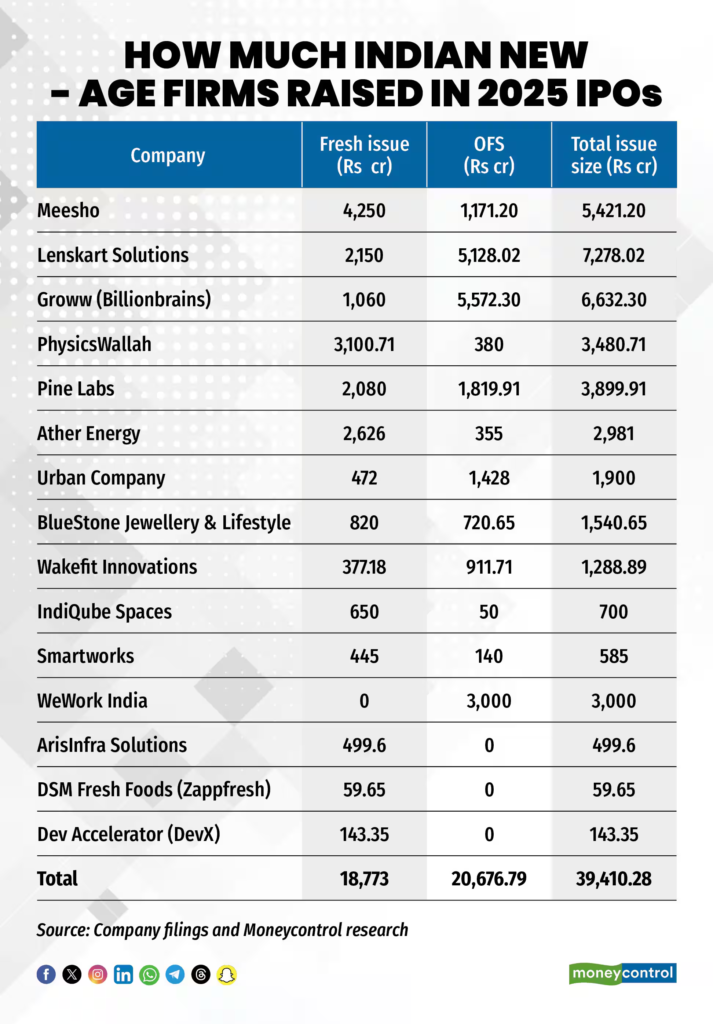
As many as 15 startup and consumer-tech companies went public this year, raising close to Rs 40,000 crore — more than 35 percent higher than the Rs 29,000 crore raised across 13 IPOs in 2024, according to a Moneycontrol analysis.
Late-stage capital availability fell meaningfully during the year, causing several companies to accelerate listing plans. Late-stage venture inflows declined almost eight percent year-on-year to $7.39 billion across 371 deals in 2025, from $8 billion across 412 deals in 2024, according to Venture Intelligence.
“When you have no late-stage private funding, that’s when people go IPO. Private markets are far more forgiving than public markets… When that tap tightens, exits start happening in the public markets,” said Deepak Shenoy, founder of investment advisory firm Capitalmind.
The newly listed firms have also tightened costs and improved profitability metrics as they approached the public markets, Moneycontrol reported earlier, driven by investor scrutiny and the need to justify valuations at listing.
Which IPOs drove the money this year?
The seven biggest IPOs — Meesho, Lenskart, Groww, Pine Labs, Ather Energy, PhysicsWallah and Urban Company — drove the year’s activity, together raising more than Rs 32,000 crore. Their share shows that 2025’s IPO momentum was led by scaled, late-stage platforms with established revenue models and brand pull.
A further Rs 4,000-plus crore came from Bluestone, Wakefit, IndiQube and Smartworks, signalling steady demand for mid-sized consumer and workspace listings in public markets. These offerings helped broaden the calendar beyond pure-play ecommerce and fintech names.
Rounding out the roster were ArisInfra, Zappfresh, DevX and WeWork India, which together raised just under Rs 3,000 crore. While smaller, these floats highlight growing investor willingness to engage with less mature or narrower business models, pointing to a public pipeline no longer restricted to unicorn-led deals.
Combined, the 15 IPOs mobilised over Rs 18,000 crore in fresh issuances that went directly into companies’ growth plans and over Rs 20,000 crore through offers of sale, enriching venture funds and early founders — making 2025 one of the strongest public exit years for early investors.
Shenoy said company maturity also helped push this year’s cohort forward.
“They reached a certain size. When you become well known, it becomes easier to go public. For smaller players without recall, it isn’t useful to IPO,” he said, adding listings also opened up exit avenues for early investors and ESOP holders.How did these listings unlock capital and exits?
Fresh issue proceeds are fuelling expansion — including technology investments, omnichannel rollouts and working capital — while secondary share sales continue to reshape liquidity patterns for India’s venture ecosystem.
Even before the recent listings, Moneycontrol reported that venture funds and early shareholders had already realised over Rs 15,000 crore (around $1.7 billion) in gains through IPO exits this year. Investors such as Peak XV Partners, SoftBank, Tiger Global and Y Combinator monetised stakes across companies, including Groww, Pine Labs, Ather Energy, Urban Company and PhysicsWallah. These gains were booked ahead of newer listings such as Meesho and Wakefit.
Investors are also sitting on significant paper value. They hold around Rs 90,000 crore (about $10.3 billion) in unrealised gains based on their remaining listed equity across these companies — underlining how this year’s IPO wave has delivered both immediate cash outcomes and substantial upside potential still on the table.
In an earlier conversation with Moneycontrol, Sumer Juneja, managing partner at SoftBank Investment Advisers, said the rise of public listings has started competing directly with late-stage private capital.
“When we started investing in India aggressively in 2017 and 2018, there was no company which had done an IPO. But now… I think today we are competing actually against the IPO market as well,” Juneja told Moneycontrol.
“It’s maybe not great for us because we are competing, but for the ecosystem, it’s phenomenal. Because the best thing you can do to any ecosystem is to give it more capital, right.”Who’s going public next year?
Momentum is expected to carry into next year, with 21 companies either filing draft papers or publicly indicating plans to list in 2026. These include Zepto, PhonePe, Flipkart, boAt, Shadowfax, Curefoods, Captain Fresh, Turtlemint, Aye Finance, InCred, OfBusiness, Infra.Market, Fractal, Innoviti, PayU and Rentomojo.
Amagi, Oyo, Avanse, Shiprocket and Zetwork are in various stages of preparation, according to bankers and market participants. The pipeline spans ecommerce, fintech, logistics, B2B marketplaces, media tech and consumer brands, pointing to another broad-based listing cycle if market conditions remain supportive.
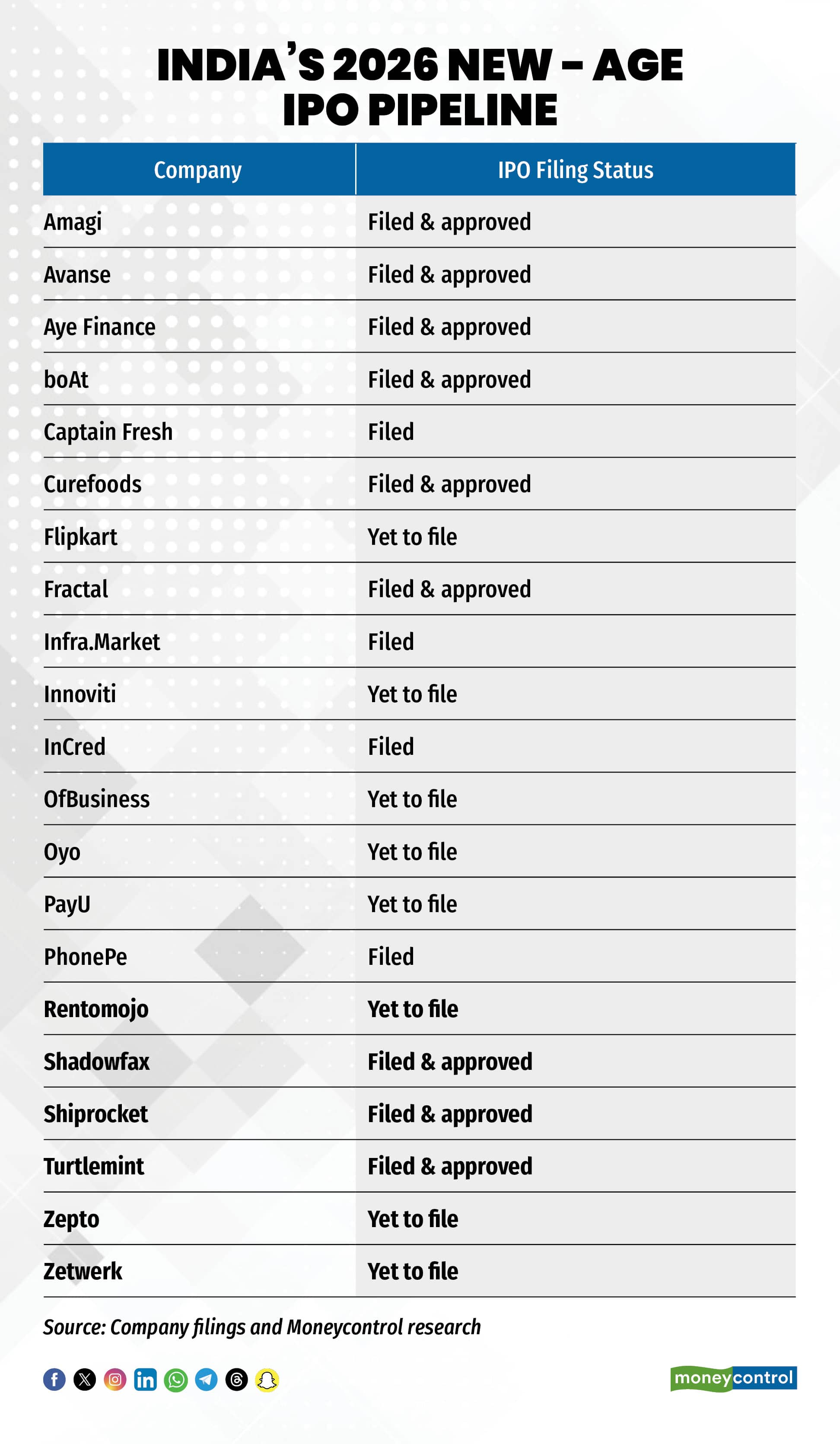
The expanding queue signals durability rather than a one-off window, analysts at Bajaj Broking Research said.
“2025 marks the start of a more sustained IPO cycle for new-age companies, supported by deeper domestic participation and a growing pool of mature startups. The outlook for 2026 remains robust, with a substantial pipeline across fintech, e-commerce, logistics and digital platforms, driven by domestic liquidity, though selectivity around valuations and fundamentals will likely continue,” they noted.What does this mean for India’s startup markets?
New-age firms now account for over 2.45 percent of India’s listed market capitalisation, nearly double the share recorded in 2021, as Moneycontrol reported earlier, underlining how public listings have pushed India’s tech presence deeper into the stock market.
For now, 2025 stands apart. More companies went public, more money was raised and more investors monetised holdings — cementing India’s transition from sporadic startup listings to a consistent, broad-based public-market cycle.